Free · Bulgaria
Why a Thracian Burial Mound Is Not an Ordinary House
Bulgaria Inside Out | BIO-CG1-F0013 | Free educational article | Kazanlak, Bulgaria
A roof-shaped question beneath a hill
From a distance, a low rise in the ground can seem an unpromising historical subject. A mound has no street address painted on its front and usually offers no visible doorway. Yet near Kazanlak, in central Bulgaria, a mound can preserve something more deliberate than a buried building. It can cover a structure created for the dead, where the choice of room, passage, decoration and placement makes an argument about how the living wished to remember them. The famous Thracian Tomb of Kazanlak asks a deceptively straightforward question: why is a built chamber under earth not simply a house that happens to be underground?
The answer matters because archaeological interpretation begins with function, not resemblance. A corridor could serve a house, sanctuary, storehouse or tomb. A round room could be a living room, workshop or ceremonial interior. A mound might be natural, accumulated or constructed. The parts acquire meaning only when their relationships, position, recorded finds and wider setting are read together. At Kazanlak, the relevant combination is a narrow entrance corridor, a round funerary chamber, paintings associated with burial ritual, and placement among other ancient burial monuments. UNESCO identifies the monument as a Hellenistic-era tomb dating to around the end of the fourth century BCE, discovered in 1944 and belonging to a large Thracian necropolis near ancient Seutopolis. [1]
It is equally important to resist the opposite shortcut: once the word tomb is established, every feature does not automatically become proof of one named king's life, one ceremony held on a certain day or one people's unchanging beliefs. A well-preserved painted surface is a remarkable source, but it is not a recording of the moment of interment. The tomb can demonstrate that certain visual subjects were chosen for a funerary place. It does not independently tell us what every attendant thought, how every household lived or what all Thracians believed.
This article offers a practical way to read the site. It separates observed architecture from interpretation, compares a burial chamber with a domestic building without assuming that all houses looked alike, and explains why a visitor usually encounters a reconstructed copy rather than the fragile painted original.
One monument, three very different dates
History becomes clearer when three dates are placed in separate columns. The tomb is associated with the late fourth century BCE, in the Hellenistic period. That is a scholarly date for the monument's construction and use, not a precise calendar year recovered from a dated inscription. It was discovered in 1944, which tells us when the modern world encountered this particular find. The UNESCO World Heritage inscription followed in 1979, an act of international recognition and conservation policy rather than an ancient event. [1]
These dates are not interchangeable. A visitor who says that the tomb “was made in 1979” has mistaken the year of recognition for the age of the monument. A museum label that gives the discovery year without the ancient date tells only part of the story. The most helpful short explanation is: constructed in antiquity; discovered in 1944; inscribed on the World Heritage List in 1979. Neither the 1944 discovery nor the 1979 inscription fixes the identity of the people buried there.
The Bulgarian Ministry of Tourism describes the tomb as accidentally found in 1944 in the northeastern part of Kazanlak and identifies it with the architecture of Thracian domed tombs. Its visitor description places the original in Tyulbeto Park and distinguishes the protected original from a nearby one-to-one-scale duplicate. [2] The Ministry presents a broader dating range in one description, while UNESCO emphasises around the end of the fourth century BCE. The responsible reader does not make these descriptions artificially identical; both locate the monument in the late classical or early Hellenistic funerary landscape, and neither provides an exact construction day.
The site lies near Seutopolis, an ancient city associated with the Thracian ruler Seutes III. “Near a capital associated with a named king” is not the same statement as “proved to be the king's personal tomb.” Names are tempting because they make historical narratives memorable. But an evidential leap from geographical association to identification of the deceased would require documentation that the association alone does not supply. [1]
The plan is the first clue
UNESCO describes two principal built spaces: a narrow corridor and a circular chamber, both with murals. [1] A corridor controls approach and movement. A circular chamber supplies a concentrated interior at the end of that approach. A visitor's conceptual journey therefore has a direction: approach, passage, interior. That sequence does not prove that every ancient participant walked the same ritual route, but it does show that the builders arranged spatial experience differently from the rooms of a house opened for repeated daily activity.
In a dwelling, we would investigate such evidence as cooking areas, hearths, drainage, repeated floor repairs, working surfaces, storage installations, refuse, entrances serving a household, and patterns of wear. None of these is a universal requirement for every domestic building; the absence of one hearth alone cannot prove that a structure was never inhabited. Archaeologists compare multiple clues, ideally with excavated deposits and settlement context. For Kazanlak the chamber's burial context and painted subject matter substantially strengthen the interpretation of funerary rather than residential function.
An underground room can resemble an above-ground room in shape. That is a useful reminder about how images deceive. Imagine tracing only the circular chamber onto blank paper. Without the passage, mound, paintings and archaeological context, the plan might look like a small pavilion. Restoring those missing layers changes the question from “What room shape is this?” to “What activities was this structure designed to accommodate?”
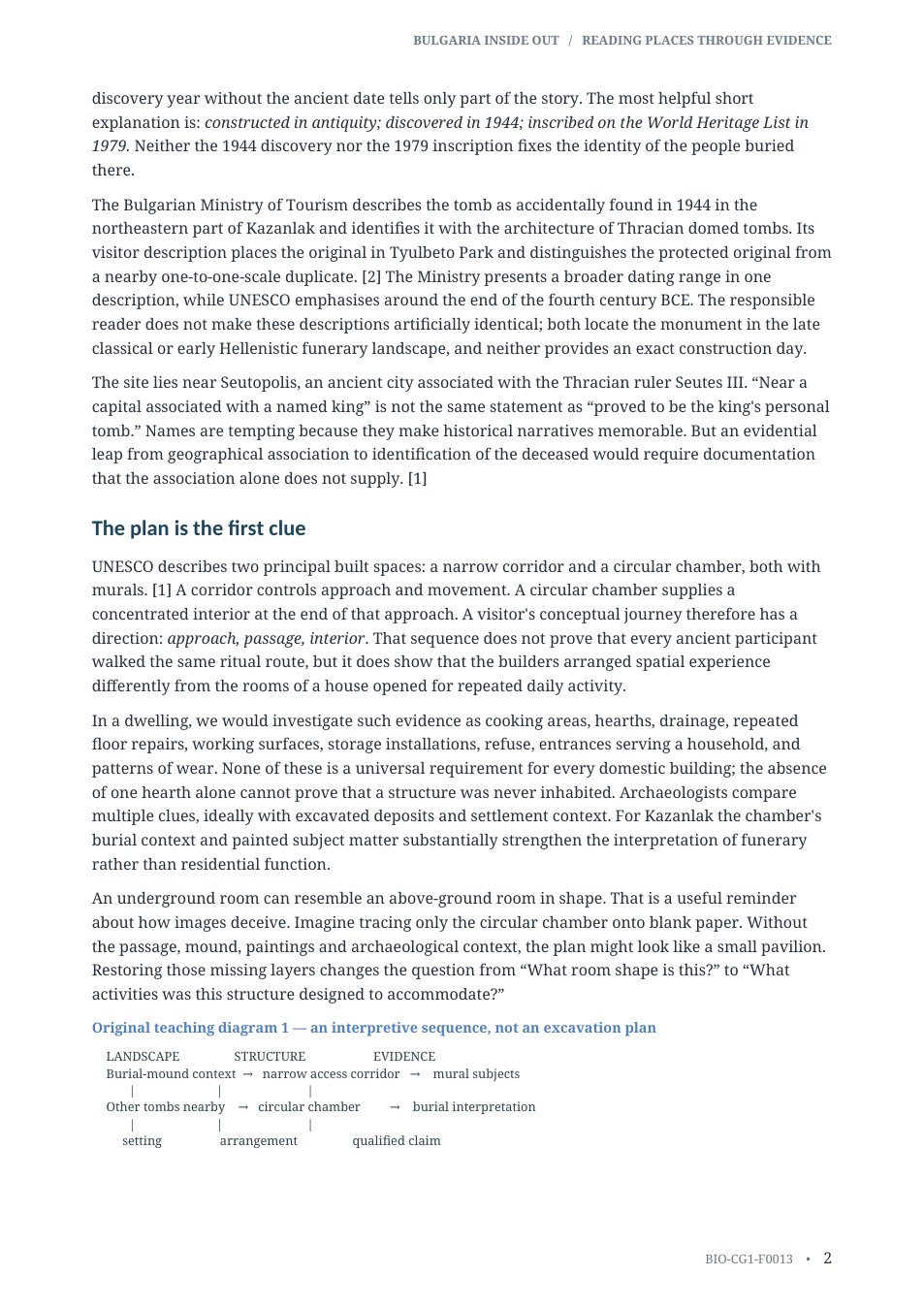
Original teaching diagram 1 — an interpretive sequence, not an excavation plan
LANDSCAPE STRUCTURE EVIDENCE Burial-mound context → narrow access corridor → mural subjects | | | Other tombs nearby → circular chamber → burial interpretation | | | setting arrangement qualified claim
This is a teaching model created for this article. It deliberately does not reproduce the tomb's dimensions, wall orientation or archaeological drawing. Its purpose is to show why any one item of evidence is weaker when stripped from the others.
What the paintings can show—and what they cannot
The mural decoration is the monument's most celebrated surviving feature. UNESCO links the paintings to Thracian burial practices and recognises their importance to Hellenistic art. Its inscription uses criteria (i), (iii) and (iv), concerning artistic achievement, cultural testimony and the development of funerary art. [1] This does not mean that every scene is a documentary photograph of a funeral. Ancient painters chose conventions, stories and arrangements intended to be seen and understood in a ceremonial setting.
The Bulgarian Ministry's more detailed description refers to warriors in the corridor and figures arranged around a seated man and woman in the round chamber. It also describes attendants, gift-bearing figures and a smaller painted band of chariots. [2] These are useful subjects for close visual reading because they organise an apparent social world: central figures, people attending them, movement, ceremony and mounted or chariot imagery. But the precise relationship between visual prominence and political authority remains interpretation. If the centrally positioned person looks important, we can say that composition suggests status; we should not announce that the image proves a universally accepted social hierarchy across Thrace.
Consider the difference between three sentences. “The chamber has painted human figures” is a statement about the visible record as documented by the site authorities. “Their placement may communicate social status” is an interpretation that can be tested through composition, comparison and specialist scholarship. “The painting records a real dinner at which these exact people gathered” is a much stronger historical claim, for which a mural alone does not supply sufficient evidence. The value of good writing is not that it eliminates interpretation, but that it labels interpretation honestly.
The paintings also illustrate the limitations of surviving colour. UNESCO notes that conservation work protected the frescoes and did not retouch or fill missing painted areas. [1] A surviving image is not identical to its original appearance in every detail. Age, preservation and documentation affect what modern eyes can know. It would be unsafe to derive a complete historical wardrobe catalogue or exact original pigment formulation from a short modern web description alone. Museum conservation records and technical publications would be needed for those claims.
A practical reader can ask four questions of a painting: What is visibly described? What organisation of figures is evident? What explanation does the institution supply? What alternative interpretation or unanswered issue remains? These questions turn aesthetic appreciation into an inquiry without pretending that a picture can answer everything.
The mound is part of the argument
A burial mound is not merely packing material around a room. The mound relates the built chamber to the surrounding landscape. It makes the place potentially legible as a memorial feature long after a burial event. Whether its ancient visibility changed over time, how its outline originally looked, and what labour was invested in constructing it would require archaeological investigation; we should not infer exact ancient dimensions or workforce from the present rise alone.
The mound at Kazanlak belongs to a broader funerary context. UNESCO calls the area a large necropolis; the Bulgarian Ministry lists other tombs and complexes in the Valley of the Thracian Kings. [1][2] A necropolis is not a “city of houses” in ordinary residential use simply because several buildings are clustered together. The term names a burial landscape. Many distinct monuments in the valley may differ in plan, chronology, burial practice and later preservation. It would be a mistake to import every detail from another mound into the Kazanlak example. The assemblage from one tomb cannot be silently treated as the inventory of a neighbour.
The landscape also gives rise to a question about who is missing from the record. Monumental stone or painted tombs can command extraordinary modern attention, while people without such monuments may be harder to locate archaeologically. A spectacular chamber can offer an important window into elite representation without becoming a representative sample of an entire society. This is especially important when writing accessible regional history. A reader should leave knowing more about what a particular funerary monument reveals, not believing that every Thracian household looked or behaved like a royal commemorative scene.
Burial archaeology can preserve traces of how the living invested materials, skills and meaning in commemoration. It often does not preserve direct statements of the deceased's wishes. The monumental character may suggest resources and social differentiation; an archaeologist would then ask for comparative evidence. The monument should make us curious about labour and social organisation, not license a fictional quotation from an unnamed ancient builder.
Grave goods, evidence and an interrupted inventory
The Bulgarian Ministry's description mentions skeletal remains consistent with two burials, a man and woman, and reports that the tomb had been robbed in antiquity. It lists certain finds associated with the mound, anteroom and chamber, including vessels, horse remains and small ornaments. [2] These details illuminate why specialists read the place as funerary. But they are reported in a modern institutional summary. Without consulting the original excavation publication, one should not claim to have independently examined the stratigraphy, confirmed the find spots or reconstructed the sequence of theft and deposition.
An object found in a tomb can support several questions: Was it a vessel for an offering, a personal belonging, a container placed for ritual reasons, or a displaced remnant? Its material and context matter. The date of an object need not equal the exact date of the whole construction. A disturbed tomb complicates matters: things may have been removed or moved before modern archaeology. The absence of an object does not prove it was never present. Conversely, the later appearance of an item in a museum display does not automatically establish that it came from this particular chamber. Its accession and excavation record must link it to the site.
The distinction between inventory and interpretation protects readers from two types of error. The first is an overconfident story told from too little evidence. The second is an overly cautious story that says nothing. We can explain that vessels, bones and decorative fragments are part of a funerary archaeological discussion while openly identifying which claims come from an institutional overview and which require deeper archaeological documentation.
Original teaching diagram 2 — an evidence ladder
Source says a vessel was found in a particular part of the tomb ↓ [recorded institutional claim] Ask where and how the vessel was documented ↓ [archaeological provenance question] Compare form, material, deposits, disturbance and parallels ↓ [specialist interpretation] Propose a role in burial practice, with uncertainty stated ≠ proof of a named individual's private thoughts
The steps represent levels of inference; they do not claim that the writer has examined unpublished excavation notes.
Why a copy can be more truthful than unrestricted access
A visitor may arrive hoping to “go inside the ancient tomb.” Modern preservation changes the answer. UNESCO says that visitors are directed to a nearby museum copy of the tomb's architecture and fresco decoration, protecting the original from visitor impacts. It also describes a protective structure and environmental control for the genuine tomb. [1] Bulgaria's Ministry of Tourism identifies the adjacent duplicate as built to a 1:1 scale. [2]
This produces an apparent paradox. The most readily visited interior is not the ancient material. Yet a faithful, clearly labelled copy can allow people to study the spatial sequence and painting composition without consuming the original through heat, moisture, contact or repeated physical disturbance. The copy tells the truth when it is presented as a copy: an educational representation constructed for access and conservation, not an untouched room from antiquity.
“Original” means the ancient structure and its surviving painted surface. “Replica” means a modern reconstruction of its reported forms and decoration. “Display” can mean either a physical visit to a copy or a museum interpretation supported by photographs, diagrams and explanatory labels. These three should not be mixed into a single claim that visitors have physically seen or touched the original. UNESCO describes the original's integrity and authenticity; the copy offers an account of those qualities rather than owning the same material age. [1]
Nor does 1:1 scale certify that every surface, missing feature or ancient light condition has been recreated exactly. The Ministry's 1:1 statement concerns the duplicate's scale and presentation. The reader should ask what has been reconstructed from documented evidence and which features involve a modern design choice. A modern light fixture, safety rail, ticket desk or explanatory sign is not a funerary furnishing. Museum design is a second layer of history: it shows how present institutions choose to communicate and protect the past.
The same principle applies when reading photographs. A photograph of the replica can be valuable, but a caption that calls the pictured plaster “the original fourth-century painting” would mislead. A photograph of the protected original, when properly credited and dated, has different documentary value. Before reproducing either, obtain or verify the image's reuse licence and label the subject accurately. No third-party images are reproduced in this article.
The museum, the valley and the limits of a ticket
The Kazanlak tomb has a specific location; it is not a generic stand-in for every Thracian monument in the region. UNESCO identifies the location in Kazanlak, Stara Zagora Province, with reference coordinates N42°37′32.7864″ E25°23′57.0192″. [1] The Ministry places the monument in Tyulbeto Park and describes the nearby duplicate. [2] A public map reference derived from the UNESCO coordinates is https://www.google.com/maps/search/?api=1&query=42.625774%2C25.399172 . This is a location aid, not a claim that the writer has visited the site or verified today's entrance route.
Iskra Historical Museum in Kazanlak maintains a virtual museum documenting archaeological heritage of the region, including Thracian tomb complexes and movable finds. [3] Its digital portal is useful for asking further questions about other sites in the valley. A separate museum database or digital image, however, should never be presented as an excavated item from this tomb without a clear institutional attribution. “The museum studies the valley” does not mean that the site under discussion contains every item featured in the museum's online collection.
Present-day opening regimes, accessibility, prices and access to original structures can change. The Ministry's general visitor page is not a guarantee of same-day admission or access to the protected original. For a visit, consult the institution's current visitor information and confirm the replica's status directly. A responsible educational article distinguishes where the monument is from which areas can be entered now.
A visitor can make one meaningful comparison even without entering the original: record how the modern approach to a protected monument differs from the ancient corridor-and-chamber sequence described in the sources. Where does the present exhibition put explanatory text? Where is the copy placed relative to the original? Which signs explain the protection of paintings? These observations become evidence of twenty-first-century heritage management, not evidence of a fourth-century burial ceremony. The distinction does not diminish the visit; it makes the visit historically more precise.
Six short field and desk exercises
-
Date sorting. Place late fourth century BCE, 1944 and 1979 next to the correct events: construction/use, modern discovery and World Heritage inscription. Explain why moving a date into the wrong column changes the story.
-
House or tomb? You see a plan of a narrow passage ending in a round room. Write one sentence that can be supported from the plan alone, then name two other types of evidence needed before deciding whether the structure was domestic or funerary.
-
Read the image carefully. Consider an institutional description of a man and woman seated with attendants in a painted chamber. Write a direct observation, a cautious interpretation and one claim that would be unjustified without further documentation.
-
Original and copy. A visitor says: “I walked into the tomb, so I have seen the ancient wall-paintings themselves.” Rewrite the statement so it accurately describes a visit to the replica and leaves the condition and access of the original unassumed.
-
Inventory check. A travel blog shows a silver jug and declares it “certainly owned by Seutes III.” List two questions that should be answered before attaching the object to that person. Where would you look first?
-
A responsible label. Write a 50-word museum label explaining what the Kazanlak tomb reveals and at least one thing it cannot establish. Include a reference to original conservation or a replica, but do not assert current entry permissions.
Worked answer key
-
Late fourth century BCE: ancient date proposed for the funerary monument. 1944: modern discovery. 1979: UNESCO inscription. Changing the categories confuses ancient action, archaeological knowledge and contemporary cultural recognition. The construction date is approximate, not an exact documentary year.
-
The plan supports the existence of an axial approach to a circular space. It cannot alone establish the occupants' activity. Seek burial-related deposits or remains, paintings, mound context, comparanda, use-wear and professional excavation records. One sign should not be treated as a universal test.
-
Observation: the description places attendants around central seated figures. Interpretation: compositional emphasis may imply status or ritual significance. Unsupported: these are portrait likenesses with securely identified personal names and an independently dated real banquet.
-
“I entered a modern replica that represents the Kazanlak tomb's architecture and decoration; UNESCO describes the ancient original as protected and its wall-paintings as conserved.” Do not claim that viewing a copy is materially equivalent to seeing original pigment.
-
Ask whether the jug's findspot is documented for this precise tomb and whether an inscription or reliable scholarly argument securely identifies a named owner. Start with the museum's excavation and accession documentation, supported by specialist publications; geographical association with Seutopolis alone is insufficient.
-
Model label (50 words): “Beneath a mound near Kazanlak, a passage leads to a round chamber decorated with funerary paintings. Dating to the Hellenistic period, the monument reveals choices in commemoration, not a complete biography of its occupants. Its ancient surfaces are protected; a replica helps visitors examine the design without damaging them.”
A compact reading method
When a beautiful ancient monument seems to tell a complete story, try a four-part note before writing about it. First, record what the authoritative source actually documents. Second, state where the evidence belongs: original chamber, replica, museum object or wider landscape. Third, name when the claim applies: antiquity, discovery, conservation or current interpretation. Fourth, identify how far the claim reaches: physical observation, institutional description, supported inference or open question. These steps need not make writing stiff; they help make it trustworthy.
The Kazanlak tomb is not an ordinary house because the full archaeological interpretation concerns a purpose-built funerary monument within a necropolis, with a distinctive spatial arrangement and burial-related imagery and finds. It also is not a magic key to every aspect of ancient Thracian life. Readers gain more by following the evidence than by filling every gap with a dramatic story. The mound preserves a powerful public act of remembrance; the limits of that evidence are part of what makes it worth studying.
Sources and provenance
[1] UNESCO World Heritage Centre, Thracian Tomb of Kazanlak, World Heritage List property 44. Site overview, Outstanding Universal Value, authenticity, conservation and reference coordinates. https://whc.unesco.org/en/list/44/ (consulted 2026-11-04). Official source supplies the approximate period, discovery, circular chamber, corridor, mural significance, inscription and conservation/replica distinction.
[2] Republic of Bulgaria, Ministry of Tourism, Thracian Tomb Kazanlak, Valley of Roses and Thracian Kings. https://tourism.government.bg/en/tourist-destinations/2800/5748 (consulted 2026-11-04). Official source supplies Tyulbeto location, 1:1 duplicate, selected excavation-summary and painting-description claims. Present visitor availability is not guaranteed by this page.
[3] Iskra Historical Museum, Kazanlak, official virtual museum portal. https://kazanlakmuseum.com/ (consulted 2026-11-04). Institution describes its responsibility for regional heritage and digital documentation of Thracian tombs and finds. This portal is used only as institutional context, not as a substitute for site-specific object provenance.
Rights and evidence: All prose, questions, models and diagrams are newly composed for this article. No museum photograph, archaeological excavation plan or copyrighted mural reproduction is embedded. Explanations paraphrase and attribute identifiable official primary-source statements; the author does not claim physical inspection. Precise original-painting conditions, admission, ticket prices, object accession, buried individuals' identity and excavation chronology beyond the cited summaries would require additional verification. Where the official Ministry and UNESCO describe dates with different levels of precision, the text retains uncertainty rather than inventing a day or exact year.